Why Orléans?
What brought you here?
It was your partner’s job wasn’t it.
Why leave the United States?
These rapid-fire interrogations have been causing my lip to curl as I assess the attitudes behind the pointed questions and lifted eyebrows. Sometimes it’s genuine curiosity, no harm no foul, and yet with others you can tell they’ve already assumed your answer.
And yes, we did move to Orléans for my husband’s job.
I’ve talked about how France was a shoot-for-the-stars kind of dream for me and my husband, because in truth we didn’t see France as a feasible option for our careers. The Nordic countries seemed more realistic. In fact, at one point we were using Rosetta stone to learn Swedish and researching how to live in the arctic circle!
Careers. . .more like career. My husband is a scientist with his PhD in geology, and he loves his work. I have a passion for maternal-fetal-health, but the politics of working in healthcare had burned me out. So, what does an aspiring author do when presented with a city-sized muse? Grab it by the horns, or croissant curls as it were, and go with it!
We never had the original Orléans on our radar, but it’s such a poetic place to land. A city we loved at first sight…even when that sight was a cold, rainy day in September.
The expat lottery brought us a community with a beautiful cathedral, rich history, and welcoming locals all nestled against the Loire. The Loire people! Other Francophiles might be having a ‘pinch me’ moment as well. We still do. The region boasts vineyards and numerous castles, but you don’t have to wander far from the Orléans city center to find lush forests, farmland, bike paths, parks, and more.
I say “original” because within the United States there is a city called New Orleans, a place with its own fantastic fusion of French, Spanish, and Creole culture. Fun fact, the statue of Joan of Arc in Place du Martroi was renovated in 1950, after being damaged during WWII, thanks to the generosity of the people of New Orleans.
Orléans has a history that spans thousands of years. All around the city you will see little gold buttons, or plaques, that are used to line walkways, denote interest, etc. They each have a doodle that pays homage to Joan of Arc as well as the words Cenabum, Aurelianis, Orléans. Three names for the same city. Cenabum dates to the Gallic period (200-50 BCE). The city’s name was changed to Aurelianis in 4 C.E after Ceasar conquered the area, and over time this fantastical name morphed into the one we have today—Orléans.
Of note: with such a rich history, time has eroded the edges of what is and isn’t known. Even when researching the meaning behind these little buttons that are scattered around the city my sources were few and far between. Above is the general consensus of Orléans naming history, per the local tourism website and Wiki, and even that is somewhat vague. I was able to find a book at our local library, “Histoire d’Orléans, les editions du bastion, par Edouard FOURNIER” which was a reprint of the 19th century edition. When looking at the bibliography, multiple works from the 1700s were used as sources/for context. Within this text Cenabum is described as a derivative of two Celtic words, “cem” or point, and “avon” or water—a description of its strategic position on the Loire for trade. The author didn’t attribute the Aurelianis name to Caesar either. He credited the name to the emperor Aurélien who came to the region around 274 to help the area rebuild. The author claims the city then renamed itself Auréliens and separated from the Carnutes (Cenabum) empire. Whew, that’s a lot. All to say…I’m doing my best here, but we all know how history has many voices.
When faced with such a rich history, how do you know what to focus on?
I walked out my front door.
Orléans is a charming patchwork quilt despite its tubulous past. Throughout the ages it has been burned, pillaged, conquered, and most recently, bombed during World War II. Everywhere you look, you are seeing different chapters in history.
When I first arrived here the medieval architecture made the biggest impression on me. It’s nearly impossible to not gawk at the Sainte-Croix cathedral when you first see it. A piece of gothic architecture that rivals Notre Dame. Once you rip your eyes away from the towers and flying buttresses, other snippets of history draw you in even further—whispering in your ear to sit down and enjoy a glass at a local cafe. Cobblestone streets, lamps that still line the historic district (Yes, I know they have light panels in them now instead of flames, but the vibes are there okay), wood beams that cut through stone and plaster, and a bridge that looks like it’s straight out of a movie.
I could go on and on. This city even fought against Attila the Hun, Attila! If any of the subjects tickle your fancy, reach out and we can explore them in the future.
All to say, in Orléans every step you take echoes with history.
I’m focusing on the medieval era, 1428-1429 C.E., as I write my historical vampire romance. I will admit the narrative leans more towards magic, mayhem, and romance than it does accurate historical facts, but it’s been a fantastically wild experience to write a story based on the history of where I’m living today.
If you are interested in:
- Exploring modern day Orléans and uncovering its vibrant past
- A romance that boasts yearning, second chances, one-tent, and more.
- Arthurian Lore with Gwen’s story like you’ve never seen it before
- Vampires of the non-sparkling variety.
Then jump onto my mailing list for some expat fun and the most up-to-date information regarding my WIP! Siege of My Heart, coming this fall!
May your days be filled with coffee, tea, and croissants…because caffeine and carbs, always.
À la prochaine,
Verona Rae
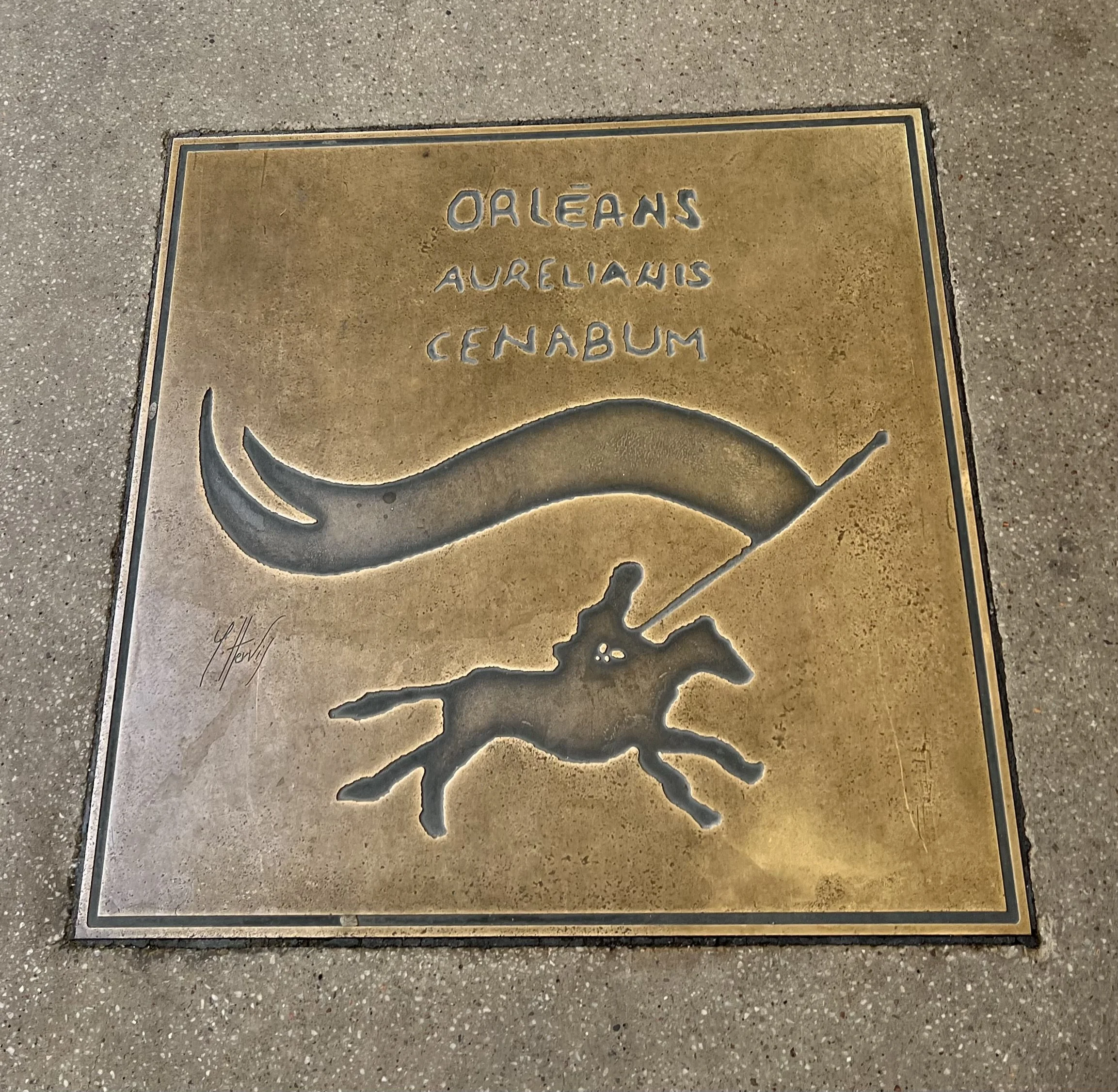
The image/graphic that I am referencing above. This is a much larger version you can find along some of the walkways.
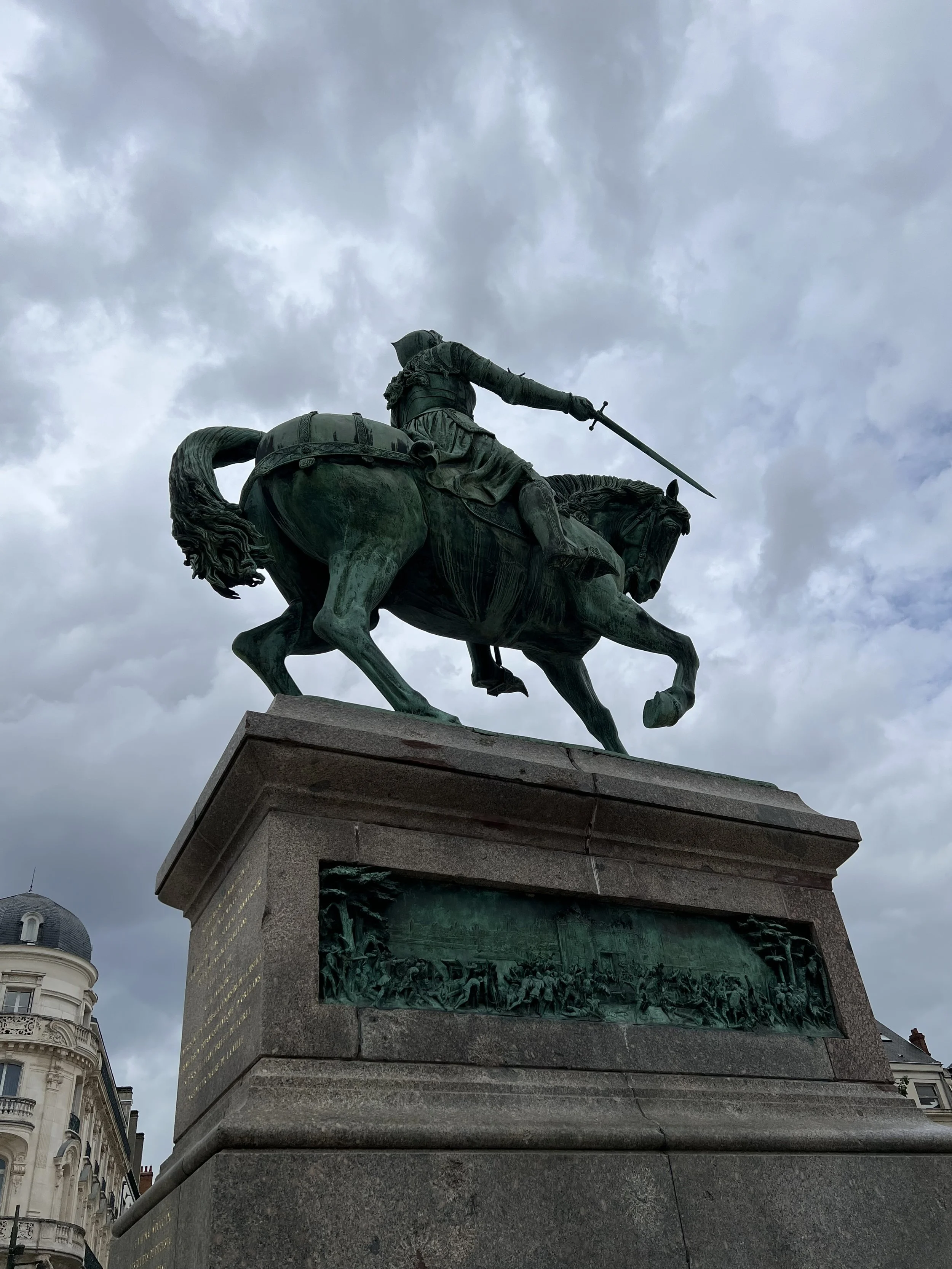
Status of Joan of Arc that is referenced above.